Barbara Kruger, Untitled (Memory is Your Image of Perfection), 1982, photograph, Museum purchase with proceeds from Museum of Contemporary Art San Diego Art Auction 2002, International and Contemporary Collectors Funds, and funds from Nancy B. Tieken.

Memory is your image of perfection
 
MCASD DOWNTOWN, 1001 KETTNER
AUGUST 3, 2008 THROUGH NOVEMBER 30, 2008

This exhibition takes its title from a black-and-white photograph by Barbara Kruger that juxtaposes text and image to call attention to the part played by memory in creating each of our realities. Photography and video are considered means of recording the past and documenting memories. Yet, memories are also constructions that respond to present desires and needs, and as such reflect individual subjectivity.

Memory Is Your Image of Perfection presents the work of women artists who, motivated by a feminist disregard for adherence to established models, have exploited the ambiguity of the photographic medium as evidence of a real event or as expression of an individual viewpoint. Works by Eleanor Antin, Uta Barth, Andrea Bowers, Suzanne Lacy, Sharon Lockhart, Ana Machado, and Yvonne Venegas, among others, span the gamut of approaches from straight documentary photography to pieces that record conceptual performances; video and photography that manipulate the physical characteristics of the medium to imply the personal and subjective; and finally to works that apply formal and narrative strategies from mass media, drawing, and painting, and transpose those into photographic forms.

The interpretive elements of the exhibition are sponsored, in part, by The Getty Foundation.


Artist Xu Bing during his residency in Mount Kenya National Park. Courtesy of the artist.

HUMAN/NATURE: ARTISTS RESPOND TO A CHANGING PLANET
 
MCASD DOWNTOWN, JACOBS BUILDING AND 1001 KETTNER
AUGUST 17, 2008 THROUGH FEBRUARY 1, 2009

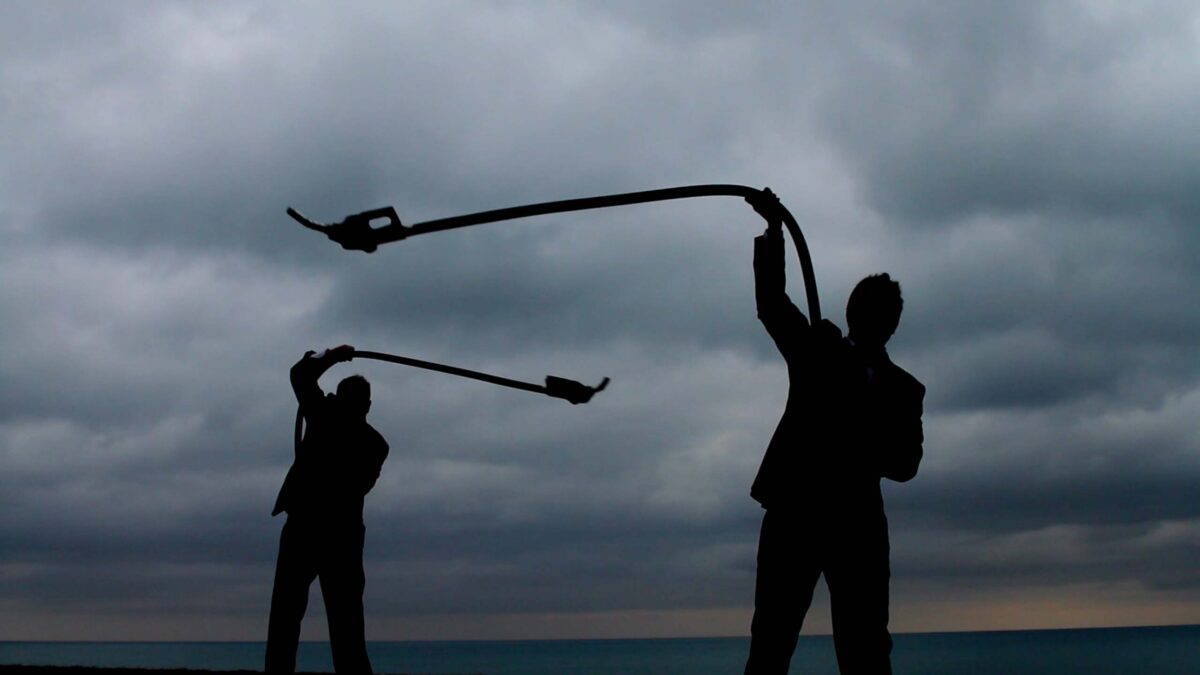
Human/Nature: Artists Respond to a Changing Planet is a pioneering artist residency and collaborative exhibition project that, for the first time on this scale, uses contemporary art to investigate the relationships between fragile natural environments and the human communities that depend upon them. This collaborative multi-year exhibition project sent eight leading artists to eight UNESCO World Heritage sites around the globe to create new work informed and inspired by their experiences in these diverse cultural and natural regions.

Organized by MCASD and the University of California, Berkeley Art Museum and Pacific Film Archive (BAM/PFA), in partnership with the international conservation organization Rare, the exhibition features new commissioned, site-specific works by Mark Dion, Ann Hamilton, Iñigo Manglano-Ovalle, Marcos Ramírez ERRE, Rigo 23, Dario Robleto, Diana Thater and Xu Bing created in response to their travels to these threatened sites. Human/Nature will also be on view at BAM/PFA from February 25 through June 28, 2009.

Human/Nature: Artists Respond to a Changing Planet is supported by The Christensen Fund, the Columbia Foundation, the National Endowment for the Arts, the Nimoy Foundation, the East Bay Community Foundation, the Baum Foundation, the Rotasa Foundation, and individual donors. In addition, the San Diego presentation is made possible, in part, by a contribution from Mary Keough Lyman. Dwell Magazine is the exhibition's official media sponsor.


John Currin, The Hobo, 1999, oil on canvas, Museum purchase, International and Contemporary Collectors Funds.

Weighing and Wanting: 25 Years of Collecting
 
MCASD LA JOLLA
SEPTEMBER 19, 2008 THROUGH JANUARY 11, 2009

Over the past 25 years, the Museum of Contemporary Art San Diego has added some 2,000 works of art to its collection, which now totals 4,131 works, having virtually doubled since 1983. Dr. Hugh M. Davies, who in September celebrates 25 years as the Museum's David C. Copley Director, will mark this anniversary with a personal, idiosyncratic selection of approximately 40 works acquired between 1983 and the present.
 
Weighing and Wanting is the first exhibition of a two-part series, and will feature smaller-scale sculpture, paintings, prints, drawings, and photography. The second part, Attempt to Raise Hell, on view in 2009 in the downtown Jacobs Building, will feature installation works. Among the artists whose work will be seen in Weighing and Wanting are Vanessa Beecroft, John Currin, William Kentridge, Nathan Mabry, Yoshitomo Nara, Martin Puryear, Bill Viola, and Lisa Yuskavage. Public educational programs for Weighing and Wanting are made possible by a grant from the County of San Diego's Community Projects Fund and Supervisor Pam Slater-Price.
 
Weighing and Wanting and Attempt to Raise Hell are both sponsored by a generous contribution from Paul and Stacy Jacobs.


Javier Ramírez Limón, from the series: Mexican Quinceañera, 2006, Chromogenic print, Courtesy of the artist.

Cerca Series: Javier Ramírez Limón
 
MCASD LA JOLLA
JANUARY 25 THROUGH MAY 10, 2009

Tijuana-based photographer Javier Ramírez Limón mines the ground between photography as straight journalistic document and as a source for conceptual and poetic interrogation. He attains this through breaks and alterations in the image’s representational façade that take various forms: textual application, digital manipulation and, as for this Cerca Series, the pairing of two independent bodies of work to create a third.

The exhibition will present two straight-photographic series that document different moments in the process of migration and adaptation of Mexican communities in the Southern United States. Ramírez Limón’s color portraits in the series Mexican Quinceañera capture central characters in real festivities celebrating the 15th-birthday of adolescent women living in San Diego County—the equivalent to “Sweet 16” parties in the United States. These images are brought together with black-and-white landscape photos taken in an area of the Sonoran desert known as Altar—a remote and dangerous region where illegal migrants and drugs are smuggled north.

Ramírez Limón conceptualizes these pairings as a form of infiltration of the social and ethnographic content of one series into the other that makes the new work at once more informative and also more open to interpretation. The landscapes infiltrate or seep into the cultural discourse of the Mexican Quinceañera series, becoming a backdrop to that celebration and its characters, offering a shorthand social history of a community.